Chicory is a very versatile plant that is equally cherished as a flower and as an herb. Though chicory is most famously used in teas, it has also traditionally been used to flavor coffees as well.

Very pretty cherry tomato that matures to a cream color. Plants are highly productive and the fruits are sweet.

Go to Shop Online.

Go to Blogger edit html and find these sentences.Now replace these sentences with your own descriptions.

Go to Blogger edit html and find these sentences.Now replace these sentences with your own descriptions.

Go to Blogger edit html and find these sentences.Now replace these sentences with your own descriptions.
Chicory is a very versatile plant that is equally cherished as a flower and as an herb. Though chicory is most famously used in teas, it has also traditionally been used to flavor coffees as well.


Hedgehog Gourd,Wild Cucumber, Teasel Gourd,hedgehog cucumber, tiger’s egg
Hedgehog or teasel gourd (Cucumis dipsaceus) has many other names including (in English) hedgehog cucumber, tiger’s egg and wild spiny cucumber. Native to Eastern Africa ( Ethiopia, Somalia, Sudan, Kenya, Uganda, Tanzania; Arabian Peninsula - Yemen) but now found all over the tropics .It is a sprawling vine 8-10 feet long
This wild cucumber has edible fruit which are very tasty when green and extremely bitter when yellow and fully ripe. It is loaded with nutrients and antioxidants so is often recommended as a nutraceutical supplement (??)
US and Canada :
Buy seeds from summerhillseeds : $2.5 for 25 s or bulk seeds from sheffields
or buy from Amazon
Asia:
Buy from Thaomoc Shop
Australia :
fairdinkumseeds


Also called Chinese okra or ridged gourd,Angled luffa,Egyptian cucumber, and also known as Vietnamese luffa . This special is a natural dishcloth, . Many ladies prefer this dishcloth.
The vigorous plant has a heavy fruit set of ridged, dark green, club-shaped fruits that are best harvested about 18” long and 2” in diameter.
Note that Chinese okra may be named for 2 Species Luffa acutangula and Luffa aegyptiaca with the same genus Cucumis.
Luffa aegyptiaca requires a long, warm growing season
Prepare fertile, well drained soil after all danger of frost in spring. Mix fertilizer with the loosened soil.
The seed coat is hard and should be soaked in warm water for 24 hours or lightly scarified before sowing.
Sow the luffa seeds at a depth equal to half their length in a warm, sunny location.
Hill planting: Create hills using a garden hoe. Leave approximately 6 feet between each hill.
Form soil into a 1-ft. diameter mound 3-4’ tall. Space mounds 4-6’ apart. On each mound plant 1-2 seeds.
Row planting: See spacing info in chart. Keep soil moist. Fertilize as needed. Hand pollination may be necessary. Train to climb a vertical support for better air circulation, straighter fruit and ease of harvest.
Apply high-nitrogen fertilizer one week after flowers appear.Feed the plants again with high-nitrogen fertilizer in three weeks.
To process for luffa sponges, allow gourds to hang on the vine until they are fully mature and the skin dries and hardens. Remove skin and seeds.
For US and Canada growers : Buy bull seeds from kitazawaseed or retail packet form parkseed ( $2.95 for 25 seeds )
Asia grower can buy from TM Garden or Vuon cua Bon
International buyer can buy directly from Amazon here.
BOTANICAL NAME
Chilopsis linearis
COMMON NAMES
Desert Willow, Desert Catalpa, Flowering Willow, False Willow, Jano
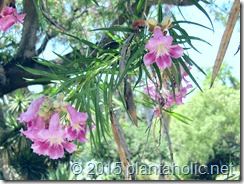
The desert willow is a little tree that adds color and fragrance to your backyard; provides summer shade; and attracts birds, hummingbirds and bees. The long, slender leaves make you think of willow, but once you learn some desert willow tree facts, you’ll see that it is not in the willow family at all.
Although its name indicates otherwise, this 10- to 15-foot shrub is not a true willow; rather, it belongs to the trumpet-creeper (Campsis radicans) family and it was named for its willow-like foliage. It blooms with large, trumpet-shaped flowers from the beginning of summer through the first frost and it is easily grown from seed.
Desert Willow is drought-tolerant, and can be found growing naturally along our ephemeral streambeds or washes, where it offers natural protection against flood and erosion damage.
The seeds in the long, thin pods grow so readily that the tree is considered invasive in some areas. Planting desert willow trees from cuttings is also possible.
One of the most interesting desert willow tree facts is that the seeds establish themselves in newly deposited river sediments after seasonal flowing. The young trees trap and hold soil sediment as their roots grow, creating islands.
When you are trying to figure out how to grow a desert willow, remember that the tree is native to the desert. Choose a planting location with full sun exposure and well-drained soil. Desert willow prefers limestone soil, but also grows well in rocky, caliches, loam, sandy and granitic soil, with minimal need for you to add any organic matter to the soil. This low-water plant tolerates dry conditions and has a high drought tolerance. Allowing it to dry out between watering it helps encourage continual blooming.
The Desert Willow's flowers, leaves and bark have all been used in hot poultices and as a soothing tea for coughs. Other known uses were as treatments to guard against yeast infections, athlete's foot and as first aid for scrapes and scratches. Tea (from the flowers) produces a natural anti-oxidant, which promotes cardiovascular health and regulates glucose metabolism.
For US and Canada growers : Buy bull seeds from sheffields or retail packet form horizonherbs ( $2.95 for 30 seeds )
Asia grower can buy from TM Garden
International buyer can buy directly from Amazon ( Around $4.99 for 30 seeds)

| sheffields | $8.95 44s |
| richters | $25.00/10g, $170.00/100g |
| sandmountainherbs | $2.25 50s |

Artemisia vulgaris ( mugwort or common wormwood ) is one of several species in the genus Artemisia . This species is also occasionally known as Felon Herb , Chrysanthemum Weed , Wild Wormwood , Old uncle Henry , Sailor's Tobacco , Naughty Man , Old Man or St. John's Plant.
Synonyms : Absinthium spicatum. Artemisia affinis. Artemisia coarctata. Artemisia officinalis
Artemisia vulgaris is a PERENNIAL growing to 1.2 m (4ft) by 0.7 m (2ft 4in) at a fast rate.
Suitable for: light (sandy), medium (loamy) and heavy (clay) soils and prefers well-drained soil. Suitable pH: acid, neutral and basic (alkaline) soils and can grow in very alkaline soils.
It can grow in semi-shade (light woodland) or no shade. It prefers dry or moist soil and can tolerate drought.
Mugwort was considered the 'universal herb for protection and prophecy' throughout the ancient world. Artemisia vulgaris was used for pain and healing, psychic powers and lucid dreaming. In ancient China and Japan, Mugwort was hung in open doorways to exorcise the spirits of disease. The ancient Europeans did the same to ward off evil spirits. These two separated cultures also believed that the supernatural powers of Mugwort were revealed by mermaids who came from the sea to present the herb for the good of humankind.
Mugwort was once the staple ingredient in beer before Hops was introduced. It was also known as Sailor's Tobacco, as it was used as an alternative when sailors ran out of tobacco at sea.
Mugwort tea was usually drunk before divination rituals and also burnt as a ‘transporting’ incense. Also known as the visionary herb, Mugwort is still used today for increasing psychic powers.
Native Americans also burned Mugwort as a ‘smudge’ to purify the spiritual and physical environment. The herbal tea was, and is still used by women for late periods
Best buy Artemisia stelleriana in US : from worldseedsupply
Best buy Artemisia stelleriana Asia: ThaoMoc Garden

Artemisia annua, also known as sweet wormwood, sweet annie, sweet sagewort, annual mugwort or annual wormwood (Chinese: 青蒿; pinyin: qīnghāo), is a common type of wormwood native to temperate Asia, but naturalized in many countries now.
It has fern-like leaves, bright yellow flowers, and a camphor-like scent. Its height averages about 2 m, and the plant has a single stem, alternating branches, and alternating leaves which range from 2.5–5 cm in length. It is cross-pollinated by wind or insects. It is a diploid plant with chromosome number 2n=18.
In Traditional Chinese Medicine the plant is referred to as Qing Hao and has been used for over 2,000 years to normalize digestive complaints. The whole herb in extracted or tea form is consumed in many countries for "digestive health" especially where sanitary conditions and insect borne infections are present.
Not for use during pregnancy.
Sow on surface of sandy soil and keep moist until germination, which is usually a week or two. Very tiny seedlings grow rapidly and transplant well. Overdose of this plant potentially toxic due to thujone content.
| Botical | Artemisia Annua | |||
| English | sweet wormwood, sweet annie, sweet sagewort annual mugwort,annual wormwood | |||
| Best Buy Artemisia Annua | worldseedsupply | $ per M | $ per G | Rating |
| horizonherbs | 2.95 200s | 15.00 | ||
| worldseedsupply | 10,000 s - ($5.50) | 1.95 | ** | |
| johnnyseeds | $3.95 500s 1/8 oz $51.90 | 8.00 | 7.41429 | * |
| rareseeds | $2 500 s | 4.00 | ||
| southernexposure | $2.5 0.05 g | 50.00000 | ||
| floralencounters | 0.06 g | 1M - $3.5 | 3.50 | 58.33333 |
Best buy Artemisia annua in US : worldseedsupply
Best buy Artemisia annua in Asia: ThaoMoc Garden


 Posts
All Comments